

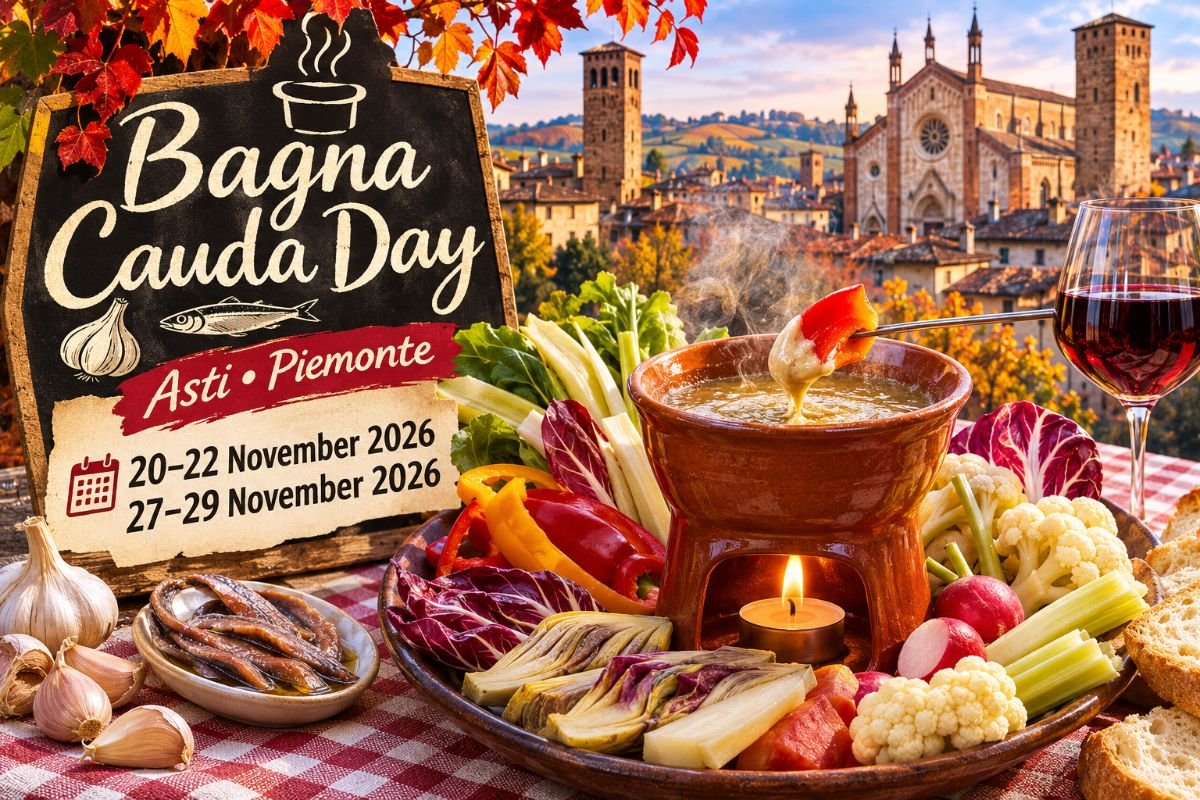
On 20–22 and 27–29 November 2026, Asti and other towns across Piedmont celebrate the fourteenth Bagna Cauda Day, a festival devoted to one of the region's most distinctive dishes. More than 160 restaurants, inns, wineries and agritourism farms will take part in shared lunches and dinners centred on a warm sauce of anchovies, garlic and olive oil served with seasonal vegetables. Asti remains the heart of the event, while participating tables are also found elsewhere in Italy and abroad.
A festival spread across restaurants rather than one square
Bagna Cauda Day began in 2013 as an initiative of the cultural association Astigiani, which wanted to preserve a regional food ritual and bring people together around the same meal. Rather than gathering every visitor at a single fairground, the event takes place simultaneously at independent restaurants, village trattorias, wineries and rural farms. In 2026 its fourteenth edition involves more than 160 establishments across Asti, Monferrato, Langhe, Roero, Turin and other places. Each venue provides its own atmosphere while sharing the central dish and the festival's common dates.
What bagna cauda is and how it is served
The Piedmontese expression bagna cauda means hot sauce or hot dip. Its traditional preparation combines garlic, salted anchovies and olive oil, warmed slowly to produce a rich, savoury mixture. Diners gather around a small ceramic vessel called a fujot, which keeps the sauce warm throughout the meal. The dish is not simply a starter eaten in a hurry: sharing the fujot is an important social ritual. Families and friends remain at the table, talk, and dip different vegetables into the warm mixture over a long lunch or dinner.
Autumn vegetables are an essential part of the recipe
The vegetables served with bagna cauda change according to local traditions and the season. Cardoons, peppers, cabbage, celery, potatoes, leeks, beetroot, turnips and Jerusalem artichokes are among the familiar choices. Some are served raw, while others are roasted or boiled before they reach the table. The November festival reflects the agricultural calendar of Piedmont, when the autumn harvest supplies many of these ingredients. A good bagna cauda dinner therefore highlights the produce of the region as much as the anchovy-and-garlic sauce itself.
Three versions of the sauce – red, yellow and green
Festival venues identify their recipes with a simple colour system. Red denotes the strongly flavoured traditional version, called Come Dio comanda, with its characteristic quantity of garlic. Yellow marks the Eretica version, in which the garlic is treated or softened to make the flavour gentler. Green identifies the Atea preparation, which contains no garlic. These labels are especially useful because the participating restaurants retain their own culinary approaches. Some also serve Bagna Sovrana, a more extensive menu built around the central dish, or a Finale in gloria featuring truffles.
20 November – the first festival dinners
The first festival weekend begins on Friday 20 November, when participating establishments open for lunches or evening meals according to their own service schedules. In Asti, examples include Albacco on Piazza Alfieri and Agriturismo Agripassione in the Valmanera area, alongside many other registered venues. The event is not a single exhibition with one entrance gate: each restaurant hosts its own tables and prepares bagna cauda in its usual kitchen. This format gives visitors an opportunity to discover both the dish and the character of individual Piedmontese neighbourhoods and villages.
21 November – the Carovana della Bagna Cauda
On Saturday 21 November, a procession of vintage cars known as the Carovana della Bagna Cauda will connect the ingredients of the sauce with their places of origin. The route is associated with Ligurian anchovies, fresh olive oil and garlic from Vessalico before continuing through Nizza Monferrato. The organisers have announced an arrival in Asti at approximately 17:30, in Piazza Libertà, where a ceremonial large fujot will be lit. The convoy offers a lively reminder that Piedmontese food traditions were shaped by exchanges between inland farming communities and the Ligurian coast.
22 November – a Sunday of meals across Piedmont
Sunday 22 November completes the first weekend with shared meals in Asti and throughout surrounding wine-producing territories. Restaurants in Monferrato, Langhe and Roero offer their own interpretations of the sauce, vegetables and accompanying dishes. Because addresses are scattered among towns, rural farms and vineyards, the festival experience is different from moving between stalls at a city fair. The choice of venue determines not only the menu but also the landscape visitors encounter. Local opening hours and available places are set independently by each establishment.
27–29 November – the second weekend and Testa d’Aj awards
The second festival weekend runs from Friday 27 to Sunday 29 November, keeping the same restaurant-based format and main dish. On the final Sunday, Asti will also host the Testa d’Aj 2026 awards at Palco 19, Via Ospedale 19, at 16:30. Those honoured include actor and musician Moni Ovadia, restaurateur Mariuccia Ferrero, actress Chiara Buratti and artist Stefano Pedro Porro. At 18:30 Moni Ovadia is scheduled to present the stage production Lezioni di umorismo with Elisa Savi. The awards and performance give the closing day a cultural dimension beyond gastronomy.
Festival price – €30 for the main dish
The organisers have set a common reference price of €30 per person for a generous serving of bagna cauda with vegetables at participating establishments. Regional DOC and DOCG wines are offered at €15 per bottle in the festival arrangement, while desserts, extra courses and complete menus can be charged separately. The common price does not make every restaurant identical: atmosphere, additional dishes and seating arrangements still vary. In particular, a Bagna Sovrana menu or a truffle-based finale may have a different price, which is set by the individual venue.
Reservations and the Sporta a cà takeaway option
There is no single ticket granting admission to every restaurant in the festival. Each participant manages its own tables, contacts and lunch or dinner times; the organiser's online directory groups venues by geographical area and lists useful information about their offerings. For those dining at home, the Sporta a cà format allows takeaway bagna cauda with vegetables to be ordered from selected locations. Both the ordinary restaurant meal and the takeaway option keep the focus on sharing the same traditional food rather than attending a central commercial exhibition.
Bavagliolone and the new Palot da Fujot souvenir
An oversized cloth bib, the Bavagliolone, is a distinctive symbol of Bagna Cauda Day and is associated with the shared meal. A different artist illustrates it for each edition; in 2026 Stefano Pedro Porro has designed a red family Volvo under the motto Questo bavaglio ci rende liberi. Organisers have also introduced the Palot da Fujot, a small metal tool developed with the historic Asti company Way Assauto. It helps move the candle beneath the heated ceramic pot and becomes a keepsake after the dinner.
Barbera d’Asti and Piedmont's wine culture
Bagna cauda belongs to a landscape where vineyards and kitchens have grown together over centuries. Barbera d’Asti, with its notable acidity and fruit character, is among the wines traditionally paired with the intense garlic and anchovy flavours. Wineries associated with the 2026 programme include Bava, Braida, Cascina Castlèt and Coppo. Their participation connects the festival to the wider agricultural and winemaking identity of the region. Wine is an accompaniment rather than the central attraction, allowing visitors to explore the interaction between seasonal vegetables, local cooking and Piedmontese grapes.
Asti – medieval streets and Monferrato hills
Asti lies in northwestern Italy and is the capital of the province of the same name. Its historic centre preserves medieval towers, brick palaces, arcaded streets and squares shaped by its past as a prosperous trading commune. Piazza Alfieri is known for the annual Palio horse race, while Torre Troyana rises above the surrounding rooftops. The Cathedral of Santa Maria Assunta, the Church of San Secondo and Palazzo Alfieri recall the city's religious, civic and literary history. The surrounding Monferrato hills are covered with vineyards and villages.
More than bagna cauda – Asti's everyday food traditions
Asti's food culture includes stuffed agnolotti pasta, local cheeses, cured meats, dishes with truffles, and desserts made with Piedmontese hazelnuts. Its wine heritage is also associated with Asti Spumante, Moscato d’Asti and Barbera. September brings the Douja d’Or and Festival delle Sagre, when food, wine and local rural history take over public spaces. Bagna Cauda Day gives November its own culinary identity without replacing the year-round restaurants and producers. The meal is a good illustration of how a modest country recipe can become an enduring regional tradition.
Getting to Asti from Milan Malpensa Airport (MXP)
Milan Malpensa Airport is a major arrival point for international travellers heading to northern Italy. Reaching Asti by public transport generally means taking the Malpensa Express and continuing by regional rail, sometimes through Milan or another interchange. An individual car journey offers a direct connection between the airport and a hotel, restaurant or winery address. ItalianAirports.eu lists the Malpensa Airport – Asti transfer route in its Asti transport directory, alongside public-transport options. Actual vehicle availability, the meeting point and the final fare depend on the independent transport company selected for the journey.
Transfer from Milan Linate Airport (LIN) to Asti
Milan Linate is closer to the city centre than Malpensa and is connected to the urban metro network by line M4. A rail journey to Asti requires onward connections through Milan's transport system and regional services to Piedmont. A private journey from the terminal can instead take passengers directly to their accommodation or chosen festival venue, which may be outside the town itself. The Linate Airport – Asti transfer route appears in the ItalianAirports.eu catalogue. A listed route is travel information, however, and does not by itself guarantee a particular operator, car category or departure time.
Transfer from Bergamo Orio al Serio Airport (BGY) to Asti
Bergamo Orio al Serio Airport, also known as Milan Bergamo, is used by many European carriers and can serve as an arrival point for Bagna Cauda Day. A public-transport trip to Asti usually involves connections between Lombardy and Piedmont, while a private car can travel directly to an agreed address. The ItalianAirports.eu directory includes the Bergamo Airport – Asti transfer route and describes road travel as an option. Travel time may change according to traffic, weather and the precise destination, particularly when the evening meal is in a village or farmhouse rather than central Asti.
Turin and Cuneo airports – alternatives within Piedmont
Turin Caselle Airport (TRN) and Cuneo Levaldigi Airport (CUF) provide two further points of arrival in the same region as Asti. Turin has broader transport connections, including railway links towards Asti, whereas the flight programme at Cuneo is more limited and depends on the operating season. The Asti also displays these airports among relevant route options. Festival venues are distributed over a wide area, so a journey to a rural winery or agritourism farm can involve an additional road segment even when a train reaches Asti itself.
The Piedmontese dish reaches tables around the world
The 2026 edition extends beyond its home region, with restaurants and Piedmontese communities participating in cities such as New York, Berlin, Shanghai, Valencia, Tallinn, Budapest and Vancouver. Some events are hosted by Italian restaurants abroad, others by community associations keeping ties with their region of origin. The international programme does not imply a centrally owned restaurant chain; it is a shared cultural initiative built around one recipe. A Shanghai dinner is scheduled for 28 November with the participation of the Italian culinary community there.
Environmental initiatives and the Bagna della Merla in 2027
Association Astigiani also links the festival to local social and environmental activities, including the Bosco degli Astigiani biodiversity project near Asti. After the November dinners, the organisers plan a winter continuation called Bagna della Merla on 29, 30 and 31 January 2027. Its name refers to the traditionally coldest days of the Italian winter, a fitting setting for a shared hot meal. The two initiatives show how the event brings together local food, community projects and the seasonal rhythm of Piedmont without turning the festival into a package tour.
Two weekends devoted to a Piedmontese tradition
Bagna Cauda Day 2026 brings together more than 160 independent venues over two November weekends, with Asti at the centre and participating tables throughout Piedmont and abroad. The common recipe, three sauce variations, local wines, cultural events and regional landscapes offer several perspectives on the same food tradition. For travellers arriving through Malpensa, Linate, Bergamo, Turin or Cuneo, the final journey depends on the particular restaurant address. The festival remains, above all, a collective meal created and served by the people who preserve this part of Piedmontese cooking.