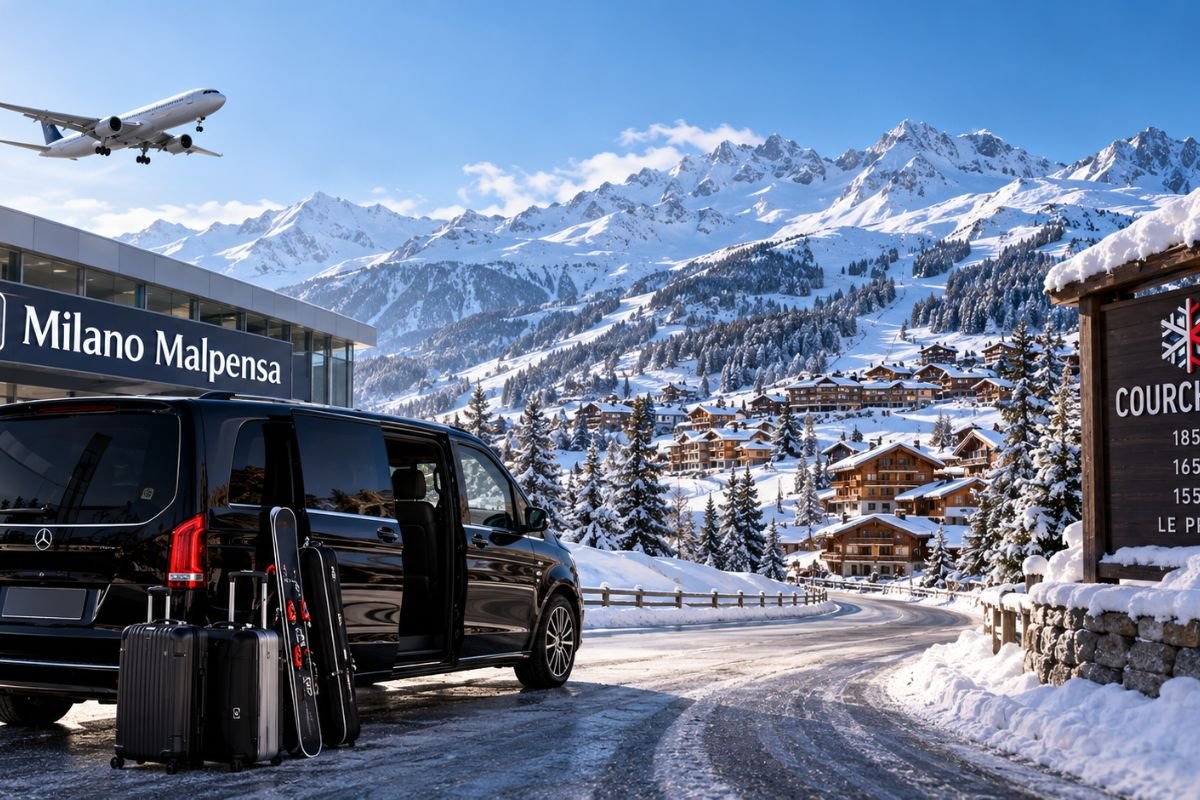


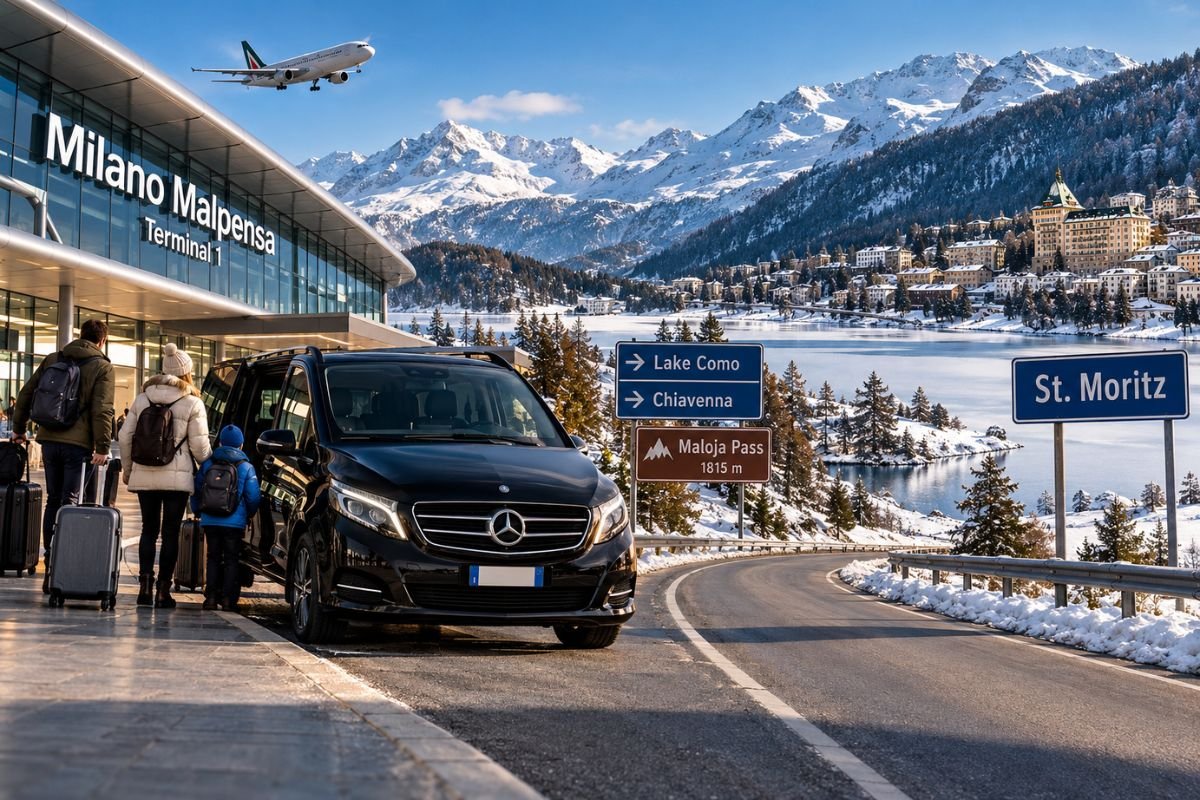
St. Moritz has long been synonymous with luxurious winter holidays, major sporting achievements and the distinctive atmosphere of the Swiss Alps. Visitors come for superb ski slopes, famous hotels, outstanding restaurants and dramatic mountain scenery. Yet the journey begins with an important decision: which airport makes the most sense? Many travellers instinctively choose Zurich without realising that Milan Malpensa Airport (MXP) is approximately 190 kilometres from St. Moritz. In favourable conditions, a transfer from Malpensa to the resort takes roughly three hours and takes passengers from Italy directly to their accommodation without changing trains. For families, groups of friends and people travelling with ski equipment, this can be a particularly convenient start to an Alpine holiday.
Why Milan Malpensa Is Worth Considering for St. Moritz
Zurich Airport might appear the obvious choice for a trip to Switzerland, but the geography of St. Moritz tells a more interesting story. The resort lies in the country's southeast, in the canton of Graubünden, relatively close to the Italian border. Travellers arriving in northern Italy can reach it by road through Chiavenna and the Maloja Pass rather than taking a major detour across central Switzerland. The distance from Malpensa is approximately 190 kilometres, with a typical journey of three to four hours depending on traffic and mountain conditions. Driving from Zurich Airport also usually takes around three hours, so the flight schedule, not simply the airport's country, should influence the decision. A convenient direct arrival can matter far more than an apparently familiar route.
Milan Malpensa is a major international aviation hub serving European and long-haul destinations. For travellers coming from North America, Asia, the Middle East and elsewhere, Milan may offer more practical arrival times, direct flights or a better choice of airlines. If flying to Zurich requires a connection while Milan can be reached nonstop, the difference in comfort and total travel time may be significant. Malpensa is situated outside Milan itself, and a journey towards Switzerland does not require a detour through the city centre. Once passengers have collected their luggage, the route can head straight towards Lake Como, Chiavenna and the Upper Engadine.
There is another reason to consider Malpensa: the possibility of combining a Swiss skiing holiday with time in northern Italy. Milan offers shopping, architecture and gastronomy, while Lake Como, on the way towards the Alps, is among Lombardy's most celebrated destinations. This makes it possible to create a varied itinerary, spending a few days in Italy before or after visiting St. Moritz. Even without such a stop, arriving at Malpensa can still be the right decision when the timetable suits the trip. The essential advantage is that a major international airport and the Swiss resort are connected by a relatively short road journey.
Why a Transfer from Malpensa Airport Is Such a Practical Solution
When booking a skiing holiday, people often compare airfares carefully but leave their onward journey until later. In reality, getting from the airport to a mountain resort can be the most tiring part of the trip. After a flight, passport formalities and baggage collection, passengers may still face railway timetables, unfamiliar platforms and multiple connections. In winter, when luggage includes skis, snowboards, boots and large suitcases, even changing from one train to another can become inconvenient. Families with young children and groups carrying their own equipment notice these difficulties most acutely.
There is no direct train from Malpensa Airport to St. Moritz. Public transport itineraries can involve Lugano and an onward bus, or travel through Milan, Colico and Chiavenna using combinations of trains and buses. Depending on connections, these journeys can take about six hours or longer. Reaching St. Moritz railway station may not even be the end of the journey, because a hotel, apartment or chalet could require an additional local transfer. As a result, travelling from the airport to the accommodation can absorb a substantial part of the day.
A transfer from Malpensa addresses precisely that problem. Passengers leave the airport by road and continue to an agreed address in St. Moritz in the same vehicle. Avoiding connections is particularly valuable after an evening arrival, for families with children and for anyone carrying several sets of skis. There is no need to make the flight schedule fit a chain of train and bus departures, which makes the journey more straightforward from beginning to end. A transfer will not always be cheaper than public transport, particularly for someone travelling alone, but it offers clear advantages in convenience, handling luggage and reaching the accommodation directly.
For families and groups of friends, the cost per passenger also deserves attention. When a vehicle is priced as a whole, the total can be divided among several travellers. A spacious minivan shared by five people, for example, may look more attractive financially than an entire vehicle paid for by one person. The group stays together, and its luggage and sports equipment can travel in the same vehicle, provided that its actual capacity is sufficient. The cost is therefore best judged alongside passenger numbers, travel time, equipment and the convenience of arrival, rather than as a single headline price.
From Lake Como to the Maloja Pass: A Journey Through Two Alpine Landscapes
One of the pleasures of this route is the variety of scenery along the way. After leaving Malpensa, the road crosses Lombardy towards Lecco, near the southeastern end of Lake Como. It then follows the SS36 along the eastern side of the lake, with substantial sections passing through tunnels and faster roads. As the journey approaches Colico, the surrounding mountains become increasingly imposing and built-up areas give way to Alpine valleys. The road is not always directly beside the water, but the region around Lake Como gives this drive a very different character from an ordinary motorway journey between cities.
Beyond Colico, the route continues to Chiavenna, an old Italian town at the foot of the Alps. For centuries, trade routes through this area linked northern Italy with the territories of present-day Switzerland. Chiavenna still has a historic centre, stone buildings and the distinctive atmosphere of a mountain town. The road then approaches the border and winds through the Bregaglia valley, passing traditional houses, small settlements and steep mountain slopes. These kilometres reveal a quieter side of the Alps, far removed from large airports and major cities.
After crossing the border near Castasegna, the journey continues through Switzerland. One of its most striking sections is the climb to the Maloja Pass, at an altitude of 1,815 metres. A succession of tight bends leads upwards and opens views over the valley far below. Here the transition between the relatively mild landscape of the Italian lakes and the winter conditions of the high Alps becomes particularly vivid. The pass connects Bregaglia with the Upper Engadine and remains an important road link between the two valleys.
Beyond the pass, the scenery changes dramatically. The narrow valley gives way to a broad high-altitude landscape with Lake Sils and Lake Silvaplana surrounded by towering mountains. In winter, frozen lakes, snowy meadows, coniferous forests and small Swiss villages create the classic Engadine landscape. The road continues through Silvaplana towards St. Moritz, which stands at roughly 1,822 metres above sea level. In only a few hours, passengers travel through two countries, from Italian Lombardy into one of Europe's best-known mountain regions.
St. Moritz: A World Centre of Skiing and Winter Luxury
The history of St. Moritz is closely linked to the development of winter tourism in Europe. During the nineteenth century, the area helped establish the tradition of Alpine holidays that later spread to resorts across the continent. Its worldwide reputation came not only from the scenery but also from major international sporting events. St. Moritz hosted the Winter Olympic Games in 1928 and again in 1948, placing it firmly among the historic centres of winter sport. That legacy remains visible in the resort's identity today.
St. Moritz offers much more than conventional skiing. Its best-known ski area, Corviglia, has approximately 155 kilometres of prepared pistes served by 24 lifts. Cable cars and lifts take visitors towards Piz Nair, whose summit reaches 3,057 metres, opening wide views over the Engadine and surrounding peaks. Skiers can choose from slopes of varying difficulty, while nearby Corvatsch, Diavolezza and Lagalb offer different terrain and mountain experiences. This range makes the region appealing to committed skiers as well as travellers looking for variety.
The resort's international fame also extends beyond sport. Historic luxury hotels including Badrutt's Palace and Kulm Hotel stand alongside high-end boutiques, fine restaurants and a busy calendar of winter events. The White Turf horse races, staged on frozen Lake St. Moritz, are among the most distinctive traditions of the season. International sporting competitions, cultural activities and social gatherings add to the atmosphere throughout the winter. For many visitors, it is this combination of mountains, history, architecture, gastronomy and elegance that makes the destination so memorable.
Choosing a Vehicle for the Malpensa–St. Moritz Transfer
A journey to the mountains places particular demands on transport because of its length and the volume of luggage. For one or two people with ordinary suitcases, a business-class saloon such as the Mercedes-Benz E-Class may be sufficient. Travellers looking for a more spacious, refined cabin may prefer a Mercedes-Benz S-Class. However, when passengers carry long skis, snowboards and several large bags, luggage capacity matters at least as much as the car's category. The actual dimensions of the equipment and available storage space should therefore determine the choice.
For families and smaller groups, a Mercedes-Benz V-Class is often practical, combining several passenger seats with room for luggage. Larger parties can travel in a Mercedes-Benz Sprinter or a similar minibus, subject to the precise vehicle layout. Such vehicles are particularly useful when a group arrives on the same flight and is travelling to one hotel or several nearby properties. Winter preparation also matters: the final section of the road may involve snow, ice and steep gradients. The appropriate vehicle depends on the route, the equipment and what the transport operator can provide.
Winter Roads in Switzerland: What the Maloja Pass Means for Travel
A considerable part of the route passes through mountainous country, so winter weather should never be ignored. Unlike some seasonal Alpine passes, the Maloja Pass is normally used throughout the year. Heavy snow can nevertheless cause temporary restrictions or closures, and snow chains may be required on particular sections. Road surface conditions and visibility can change rapidly when the weather deteriorates. This is why an estimated driving time is not a guarantee of the actual duration of a winter transfer.
The busiest holiday periods can also cause delays. Christmas, New Year, school ski holidays and major sporting events place extra pressure on roads in Lombardy and on approaches to Swiss resorts. In good conditions, the drive from Malpensa to St. Moritz usually takes a little over three hours, but snow or heavy traffic can make it substantially longer. The journey also crosses the border between Italy and Switzerland, where document checks and customs procedures are possible. These practical details deserve attention alongside the choice of flight.
How Much Does a Transfer from Malpensa to St. Moritz Cost?
The cost depends on the vehicle category, passenger numbers, departure time and the operator's conditions. Business-class saloons, luxury cars, minivans and minibuses may all be offered on the same route, so prices cannot be compared sensibly without accounting for capacity. Group travel changes the calculation again, because a vehicle's overall cost can be shared between passengers. The size of the luggage, ski equipment and requirements of the winter road may also affect the service. A quotation needs to be assessed in terms of what is included, not just the price shown at first glance.
ItalianAirports.eu provides a dedicated page for the transfer from Milan Malpensa Airport to St. Moritz, bringing together the road distance, estimated travel time, vehicle classes and transport companies. Indicative price ranges quoted in the article are €380–460 for a Mercedes-Benz E-Class, €460–550 for an S-Class, €500–600 for a V-Class and €840–1,010 for a Sprinter. These figures are for reference, not a binding offer: the transport company confirms the final price, terms and vehicle availability. Passenger numbers and luggage requirements should always be taken into account when comparing categories.
These figures also allow groups to estimate their cost before departure. If a V-Class costs €500–600, a party of five would be looking at approximately €100–120 per person when the total is shared equally. For a family or group with several suitcases and sets of ski equipment, that may represent reasonable value given the reduced travel time and absence of connections. The final price still depends on the actual operator's offer, so the calculation is only an illustration of how a shared vehicle can work financially. It should not be treated as a confirmed fare.
Beyond St. Moritz: Other Upper Engadine Destinations
St. Moritz is the region's most famous name, but the Upper Engadine has many other places to stay during a winter holiday. Silvaplana, Celerina, Pontresina, Sils im Engadin and Samedan are all nearby, and each has its own character. Silvaplana is attractive for access to Corvatsch, while Celerina is conveniently placed for the Corviglia slopes. Pontresina is appreciated for its mountain scenery and calmer atmosphere. Many visitors stay in these villages while enjoying the wider Engadine's skiing and visitor facilities.
A transfer from Malpensa can be just as useful for these destinations because the vehicle can continue directly to the agreed hotel, apartment or chalet. Depending on the address, the journey may finish before St. Moritz or extend beyond it to a neighbouring village. This is especially relevant for guests renting accommodation away from the town centre or the railway station. Malpensa is therefore a practical arrival airport not just for St. Moritz itself but also for much of the Upper Engadine.
From Milan to the Swiss Alps: When the Journey Becomes Part of the Holiday
A ski holiday begins long before the first lift ride. The choice of flight and airport affects how much time is spent travelling, how easily luggage can be transported and how guests feel when they reach their accommodation. Milan Malpensa merits serious consideration thanks to its international connections and road access to southeastern Switzerland. Only around 190 kilometres separate the airport from St. Moritz, with a route that passes Lombardy, Lake Como, Bregaglia and the Maloja Pass. The combination of a manageable distance and memorable landscapes gives the journey an appeal of its own.
The essential advantage of a transfer from Malpensa to St. Moritz is that it links the flight with the final leg to the resort without a chain of complicated connections. For families, groups of friends and travellers with ski equipment, this means fewer transport problems, easier handling of luggage and arrival at the actual accommodation address. Along the way, passengers encounter two different Alpine worlds: Italian lakes and valleys followed by the snowy mountains of the Swiss Engadine. For many travellers, the journey to St. Moritz can therefore begin not in Zurich, but at Milan Malpensa Airport.