

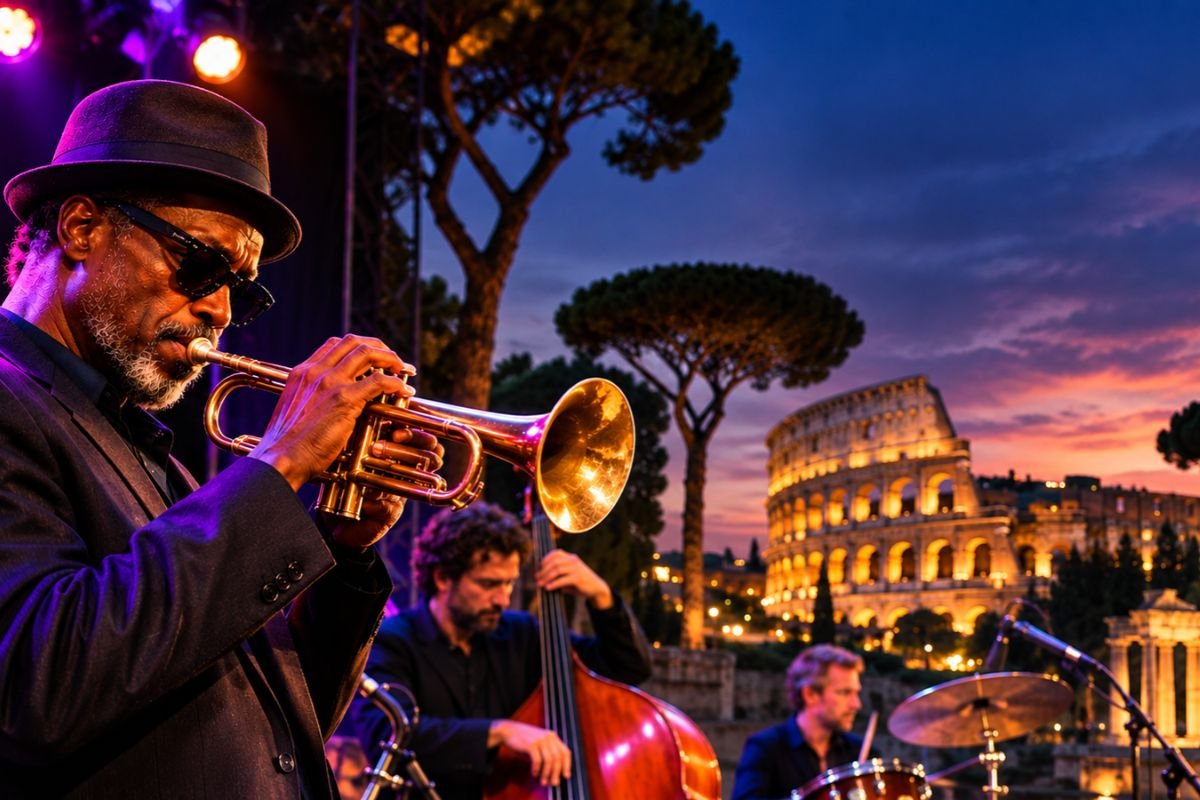
From 1 to 24 November 2026, the Roma Jazz Festival celebrates its 50th edition with concerts across the Italian capital. The programme honours the centenary of Miles Davis and brings international jazz musicians to Auditorium Parco della Musica, Casa del Jazz and Alcazar.
Fifty editions of jazz in the Eternal City
The festival began in 1976 at the Quercia del Tasso on Rome’s Janiculum Hill. What started as a local concert series became a fixture of the European jazz calendar. Across five decades, its stages have welcomed Dizzy Gillespie, Sarah Vaughan, Sonny Rollins, Wayne Shorter, Herbie Hancock, Chick Corea and many other artists. More than a thousand concerts later, the festival remains interested not only in preserving jazz history but in following the music as it changes.
The anniversary offers a different reason to visit Rome. Rome is usually associated with ancient monuments, Renaissance palaces and crowded landmarks, yet its concert halls and intimate clubs reveal a cultural life that continues long after museum closing time. A November trip can combine a daytime walk through the city with an evening performance, without treating the concert as an isolated excursion.
Why Miles Davis is at the heart of the 2026 edition
The festival’s theme, “Rileggere Miles, ripensare il jazz” – revisiting Miles, rethinking jazz – marks 100 years since the birth of Miles Davis in 1926. The trumpeter reshaped modern jazz repeatedly: from the cool and modal movements to the electric experiments that brought improvisation into dialogue with rock and electronic instruments. His influence is still heard in musicians who refuse to stay inside a single genre.
There is also a direct connection with Rome. Davis appeared in the city more than once, and his final Roman concert took place at the Olympic Stadium on 23 July 1991. The anniversary programme does not simply recreate famous recordings. It gives contemporary performers room to reinterpret his approach to rhythm, composition and experimentation. Jason Miles, who worked on Davis’s music in the 1980s, provides a particularly close link between that history and the festival’s closing concert.
The programme: established names and new interpretations
The edition opened on 1 November with Paolo Fresu’s “Kind of Lives”. Kurt Elling and Yellowjackets followed on 4 November with “Celebrate Weather Report”; Steve Coleman and Five Elements appeared on 5 November, and Gonzalo Rubalcaba performed with Hamilton de Holanda on 6 November. These concerts trace different strands of jazz, from contemporary vocal music and fusion to rhythmically adventurous instrumental playing.
From 13 November, the calendar includes Eleonora Strino Trio with “Lumithia” and Nexus Quartet with “Appunti di Viaggio” on 14 November. Enzo Favata brings “Atlantico Reunion” on 16 November, followed on 17 November by Erik Truffaz and Antonio Lizana with “New Sketches of Spain”. On 18 November drummer Gregory Hutchinson presents “Kind of Now – The Pulse of Miles Davis”, a project that places the trumpeter’s legacy in a modern rhythmic setting.
The Casa del Jazz Orchestra performs “Tenor Madness” on 19 November, Omasta appears on 20 November and Jeremy Pelt Quintet plays on 21 November. On Sunday 22 November, a morning jazz story for children, “I Musicanti di Brema Swing Band”, is followed by Rosa Brunello’s “We Are Surging Waters” in the evening. Chiara Civello and Clap! Clap! present “CCCC” on 23 November, while Jason Miles closes the festival on 24 November with “100 Miles for Miles Davis”. Separate events take place in Rieti on 15 November and at Fossanova on 22 November.
Three Rome venues, three different experiences
Auditorium Parco della Musica Ennio Morricone, designed by Renzo Piano, is the festival’s major modern concert complex. It stands in the Flaminio district, away from the busiest archaeological attractions, and includes halls of different sizes. The adjacent area also contains MAXXI, the museum of 21st-century arts, making it possible to combine a concert with contemporary architecture and exhibitions.
Casa del Jazz occupies the grounds of Villa Osio near Porta Ardeatina. Smaller ensembles benefit from its more intimate atmosphere, in which the dialogue between musicians becomes part of the experience. It also lies within reach of the Baths of Caracalla and the area leading towards the ancient Appian Way, providing a natural link between a historical walk and a performance.
Alcazar is located in Trastevere, a neighbourhood of narrow streets, restaurants and lively evenings. A concert there works particularly well after a walk around Piazza di Santa Maria in Trastevere or the Tiber. These venues are not interchangeable: their locations affect the best choice of hotel, public transport and return journey.
Rome before the concert: history, neighbourhoods and guided visits
For first-time visitors, the Colosseum, Roman Forum and Palatine Hill provide a powerful introduction to ancient Rome. Piazza Navona, the Pantheon and the surrounding streets tell a different story, shaped by later centuries of art and architecture. Yet an itinerary built around the actual venue is often more practical than attempting to cross the whole capital immediately before an evening performance.
For a concert at the Auditorium, the Flaminio area, MAXXI and Villa Borghese make a coherent daytime programme. For Casa del Jazz, the Baths of Caracalla and the Appian Way are sensible historical companions. For Alcazar, Trastevere and the Tiber offer a slower walk followed by dinner. A professional local guide can explain these places in depth, while independent visitors can use the same geography to plan their day. No guided tour is implied to be operated by ItalianAirports.eu.
Arriving through Fiumicino Airport (FCO)
Rome Fiumicino Airport (FCO) is Rome’s main international gateway. The Leonardo Express runs directly between the airport and Roma Termini, while the regional FL1 serves Roma Trastevere, Roma Ostiense and Roma Tiburtina but does not stop at Termini. This distinction matters: a traveller staying in Trastevere may find a different rail connection convenient from someone staying near the main station.
An independently booked private transfer is another option when arriving with luggage, travelling in a group or heading directly to accommodation near a concert venue. Rather than assuming that “central Rome” is one destination, compare the final address with the venue itself. Auditorium Parco della Musica, Casa del Jazz and Alcazar sit in separate districts, so travel plans should reflect the concert actually booked.
Arriving through Ciampino Airport (CIA)
Rome Ciampino Airport (CIA) is Rome’s second airport and handles many European connections. There is no railway station inside the terminal. Travellers can use direct coaches to Roma Termini, or take a bus to Ciampino railway station before continuing by train. Bus links towards Anagnina metro station offer another route into the city.
For evening events, the choice between a coach, public transport and a private driver depends on arrival time, luggage and the last part of the journey. A transfer arranged with an independent operator may avoid further changes, but availability and meeting instructions must be confirmed with the actual company. ItalianAirports.eu is an information portal, not the transport operator.
Tickets and practical details
The 50th Roma Jazz Festival runs from 1 to 24 November 2026. Concerts take place at different times and in different halls; the programme also includes a children’s performance and two events outside Rome. There is no single ticket price for the entire festival. Prices, seat categories and availability depend on the chosen concert and ticket seller.
The full calendar is published in the official festival programme. Because locations and start times vary, the exact ticket and venue details are more useful than a generic travel estimate. For airport information and the city’s transport context, the linked pages on ItalianAirports.eu provide separate guides to Rome, Fiumicino and Ciampino.
A musical reason to discover Rome in November
Roma Jazz Festival 2026 is more than an anniversary retrospective. Its programme places the musical imagination of Miles Davis alongside artists developing their own sound today. A visit can move from Roman antiquity to contemporary architecture, from a small jazz room to an evening in Trastevere. Choosing the right airport connection and keeping the concert venue in mind makes those very different experiences fit naturally into one journey.