

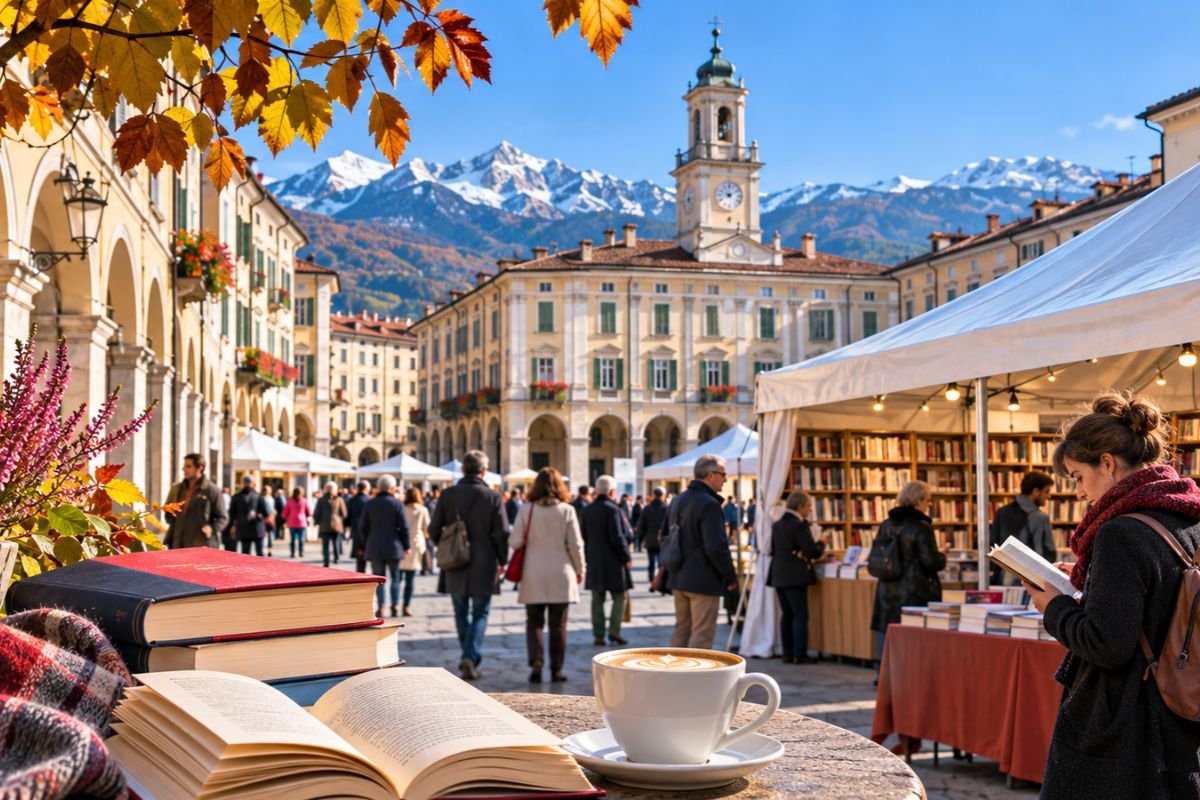
From 11 to 15 November 2026, Cuneo in Piedmont hosts the 28th scrittorincittà literary festival. More than 200 meetings bring together novelists, journalists, historians and readers across 14 venues. The theme, Finestrini, explores how books open windows onto other lives and a changing world.
For five days, the northwestern Italian city becomes a meeting place for literature, theatre, music and ideas. The festival is not confined to a single exhibition hall: events unfold in libraries, theatres and cultural centres throughout Cuneo. Visitors can combine a discussion with a favourite author with a walk beneath the city's arcades, a museum visit or a taste of Piedmontese cuisine. The programme is particularly rewarding for travellers already in Turin or arriving through airports in northern Italy.
From local reading initiative to a major cultural event
The first edition of scrittorincittà took place in 1999. Its name, roughly 'writers in the city', describes a simple concept: literature should become part of everyday urban life rather than remain behind the doors of specialist institutions. Over the years, the event has grown into an important appointment on Piedmont's cultural calendar while retaining direct conversation between readers and authors at its centre.
The 2026 edition offers more than 200 encounters, including fiction presentations, discussions about history and current affairs, performances and workshops. The festival also works with schools throughout the year. Its programme for younger audiences is not an afterthought: children can meet writers and illustrators, take part in activities and discover the pleasure of reading at their own pace. School sessions run mainly on weekday mornings, while the public programme fills afternoons, evenings and the weekend.
Finestrini – books as windows onto the world
Finestrini means the windows of a train, bus or other vehicle. A passenger sees different landscapes passing by and, once darkness falls, the glass begins to reflect the faces inside. The organisers use this image to describe reading: books can show unfamiliar places and perspectives, but they also reveal something about the reader.
The metaphor connects literature to questions that extend well beyond bookshelves. The programme considers migration, conflicts, the climate, artificial intelligence, identity and the ways people care for one another. A screen can be another kind of window, but it does not necessarily help us understand the person on the other side. Discussions, storytelling and workshops approach these questions in different ways for adults and young audiences.
Highlights from 11 to 15 November
The festival opens on Wednesday 11 November with meetings that bring together international reporting, fiction and social themes. Journalist and writer Asmae Dachan discusses Syria, memory and family histories, while Enrico Franceschini presents Arrivederci Londra. In the evening, Concita De Gregorio brings Un'ultima cosa. Voci di empowerment femminile to the stage, accompanied by live music from Erica Mou. Through the stories of five women, the performance moves between journalism, biography and theatre.
Thursday 12 November turns to knowledge, philosophy and how we interpret a complex world. Massimo Polidoro introduces Breve storia della conoscenza, tracing how discoveries and ideas have changed human life. Meetings with philosophers, journalists and researchers explore the value of language and questions facing contemporary society. The evening at Teatro Toselli combines poetry and music in Le foglie hanno perso gli alberi.
On Friday 13 November the Premio Città di Cuneo per il Primo Romanzo recognises emerging novelists. Readers' groups meet the shortlisted authors during the morning, with the winning first novel announced at the new ESSECI Auditorium at 18:30. Music and storytelling continue elsewhere in the city, making Friday an attractive choice for visitors interested in both literature and live performance.
Saturday 14 November begins with Book&Breakfast, a literary breakfast dedicated to Agatha Christie and the enduring appeal of Poirot and Miss Marple. Across the day, writers and specialists discuss the environment, migration, politics and contemporary fiction. Diego De Silva returns to his popular character Vincenzo Malinconico, while evening performances give the festival another dimension beyond the printed page.
The final day, Sunday 15 November, includes Gustavo Zagrebelsky reflecting on peace and war, and John Niven presenting a personal book about family and loss. Other conversations move between classical mythology, music and contemporary novels. The finale is entrusted to artist Gek Tessaro, whose luminous theatre turns the festival's window motif into a visual performance. The programme offers far more choices than one visitor can attend, so the locations and starting times matter as much as the authors' names.
A festival spread across Cuneo
The main base is the Centro Incontri della Provincia at Corso Dante 41. It hosts numerous events as well as the festival bookshop. Concerts, discussions and shows also take place at Teatro Toselli, Cinema Monviso, Auditorium Foro Boario and other venues. The festival stretches across 14 locations, so two consecutive sessions may not be in the same building.
A notable newcomer is ESSECI, the new cultural hub inaugurated in September 2026. It houses Cuneo's civic library collections, reading and study areas, spaces for younger visitors, an auditorium and the multifunctional sclab. For the first time, festival audiences can explore this new meeting place through talks, workshops and performances.
There is no single festival admission covering every session. Some events are ticketed; others are free but require a reserved place, while certain exhibitions are open without booking. Online reservations began on 4 November. Details of individual events, availability and any changes appear in the official festival programme; entry conditions and box-office information are explained on the official tickets page. Cuneo's historic centre includes a limited-traffic area, and Via Roma is pedestrianised, so car access to the venues should not be assumed.
Discover Cuneo between author meetings
Cuneo occupies a raised plateau between the Stura and Gesso waterways with the mountains of the southwestern Alps on the horizon. Its shape gave the town its name. The historic centre is compact enough to explore on foot, making it possible to fit a meaningful city walk between two festival events. The Cuneo destination page on ItalianAirports.eu provides the city's geographical context and connections with nearby airports.
Piazza Galimberti is the natural starting point. Its broad open space and arcaded facades lead towards Via Roma, a street of historic buildings, cafés and shops. The Civic Tower recalls medieval Cuneo, while the former Franciscan complex now houses the Museo Civico, whose collections trace the area's history from prehistoric times onwards. The Contrada Mondovì quarter adds another layer of local history to a walking itinerary.
For a quieter break, the Gesso and Stura River Park offers green surroundings close to the urban area. Cuneo also has an unmistakable culinary identity: its celebrated Cuneesi al Rhum are chocolate sweets with a rum-flavoured filling, while Piedmontese restaurants serve agnolotti del plin, vitello tonnato and other regional specialities. These are reasons to spend more than just the length of a single talk in the city.
A local guide can explain the architectural and historical background of these sights, but a guided excursion is not currently presented as a separate bookable product on ItalianAirports.eu. The festival and city walk can also be enjoyed independently.
Reaching Cuneo from Italian airports
The closest airfield is Cuneo Levaldigi (CUF), although flight options may be limited. Turin Airport (TRN) is another practical arrival point; from Turin, travellers can continue by rail or road. The most convenient airport therefore depends on the flight schedule, where the traveller is staying and the timing of the chosen festival events.
For international arrivals through Milan, ItalianAirports.eu publishes dedicated route information for a private transfer from Milan Malpensa Airport to Cuneo. This is a direct road journey across Lombardy and Piedmont, avoiding the need to move luggage between trains or buses. The actual availability, vehicle and fare are agreed with the independent operator shown on the route page, not with the information portal itself.
A second option is the Milan Linate Airport to Cuneo transfer route. Linate is often relevant for travellers using domestic or European flights. The journey by public transport may involve transfers through Milan; an individually arranged car offers a different way of reaching a hotel or another address in Cuneo directly.
Travellers arriving on flights to Orio al Serio can examine the Bergamo Airport to Cuneo private-transfer route. In each case, it is sensible to allow for baggage collection, road traffic and the location of the final destination. For a late evening event, the return journey deserves attention as well. Routes from Cuneo and Turin airports are described as transport choices, but the site's links for those two airport transfers currently open a general search rather than a dedicated service page.
A journey shaped by books rather than a timetable
One day in Cuneo can include a morning walk through Piazza Galimberti and Via Roma, an afternoon author meeting and an evening performance. A longer stay leaves time for the civic museum, a relaxed meal and more than one strand of the programme. Because popular events may fill up, an itinerary should be built around the actual sessions and venues, not simply around the festival dates.
Scrittorincittà gives a different perspective on travel in northern Italy. The event makes literature part of the streets and public life of a city that is often overlooked beside Turin and Milan. Its Finestrini theme is particularly fitting for visitors arriving by train, plane or car: the journey reveals an unfamiliar landscape, and the books offer another window through which to understand it.