

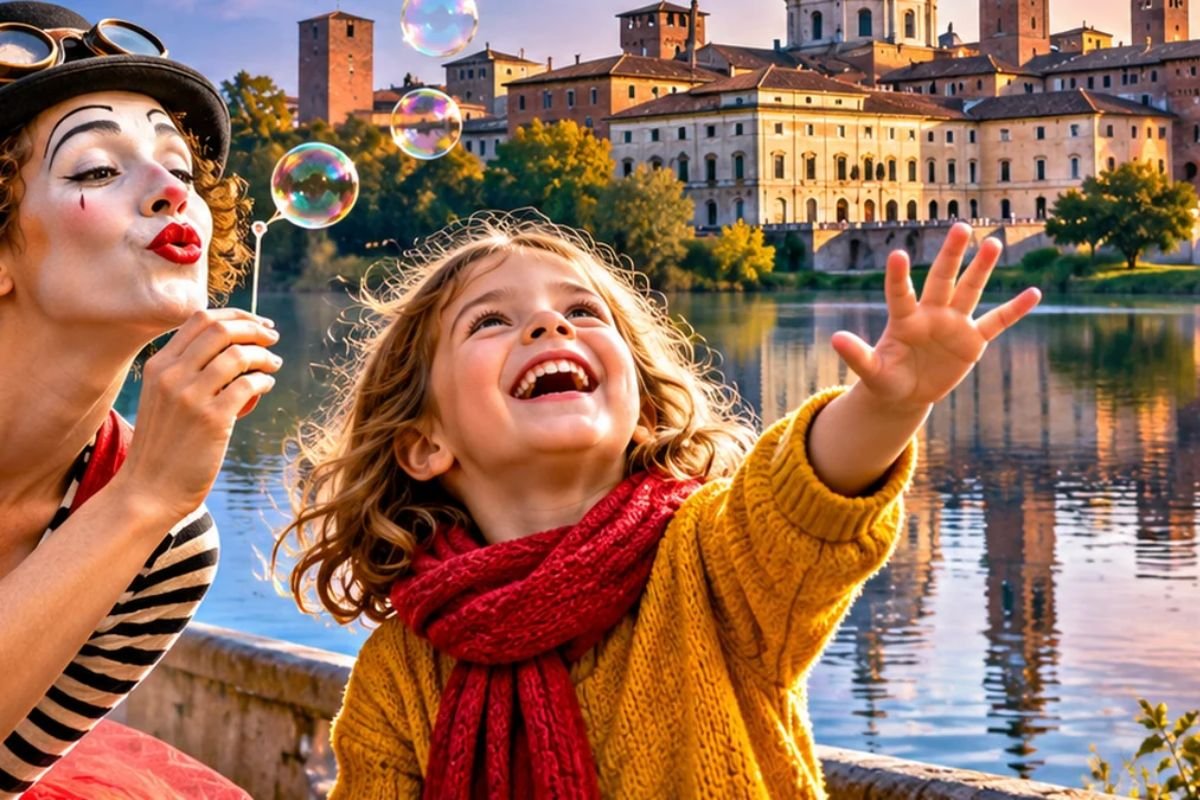
From 12 to 22 November 2026, Mantua hosts the 21st SEGNI New Generations Festival. For eleven days, historic palaces, theatres and cultural spaces welcome performances, dance, music and creative workshops for children, teenagers and adults.
In Mantua, the festival is far more than a series of children's shows. Performances take place in buildings that are themselves part of the city's artistic heritage, allowing families to explore contemporary theatre while discovering one of the great Renaissance cities of northern Italy. The 2026 edition also extends into the province, with events in Suzzara and Castellucchio.
The programme brings together established international companies, emerging artists and projects developed with young people. Visitors can combine a performance with a guided walk, a museum visit or an evening in Mantua's historic centre. Getting there is possible by train or by road from Verona, Bergamo and Milan, including private transfers operated by independent transport companies.
Twenty-one editions of a festival that grew beyond children's theatre
SEGNI began in 2006 as Segni d'infanzia, an event dedicated to artistic experiences for young audiences. Its founders approached children not as passive spectators but as people capable of understanding sophisticated visual languages, movement, humour and storytelling. From the outset, the programme favoured productions that invited curiosity and participation rather than simply retelling familiar fairy tales.
As its audience grew, the festival broadened its scope to include adolescents, young adults, parents, teachers and cultural professionals. In 2016 it adopted the name SEGNI New Generations Festival. Its performances now welcome audiences from as young as twelve months, while other events address older teenagers and adults through contemporary dance, sound art and experimental theatre.
The 2026 programme marks a new chapter in artistic leadership. After twenty years, Cristina Cazzola shares the direction with Monica Colella, while a group of Generation Z participants takes part in shaping the programme. Two complementary perspectives guide the selection: one organises performances by recommended age, and the other opens a space for teenage and adult interests. The age guidance helps families choose suitable events, but it does not imply that a production for younger spectators has nothing to say to adults.
The cow as the 2026 symbol – a story about our connections
Each edition of SEGNI adopts an animal as its emblem, using it to explore a theme that connects creativity with everyday life. In 2026 the animal is a cow. This seemingly familiar figure encourages audiences to think about the relationships linking people, other living creatures, agriculture, landscapes and the environment.
The choice is especially resonant in Lombardy, a region with deep agricultural and dairy traditions. Throughout the programme, questions about coexistence and the natural world appear in imaginative installations, movement-based performances and workshops. Children can approach these ideas through play, while older audiences discover more complex interpretations of responsibility and shared space.
What families will see – theatre, drawing, dance and discovery
SEGNI is known for the variety of its stage languages. Puppetry, live drawing, physical theatre, music and installations coexist with conventional performances, and many events rely more on images and movement than on spoken dialogue. That is a particular advantage for international visitors who may not understand every word of Italian.
One example is SCOOOOOTCH! by the French company Les Nouveaux Ballets du Nord-Pas de Calais, a performance for children aged two and above. Everyday adhesive tape becomes a tool for drawing boundaries, creating objects and transforming the stage. An apparently simple material reveals how movement and imagination can turn routine gestures into theatre.
In Pinocchio di qua e di là, Teatro all'improvviso revisits the famous puppet story through images drawn live on stage. The drawings of Dario Moretti and music by Saya Namikawa create an evolving world in front of the audience. This 2026 Italian premiere is suitable for children from three and shows how illustration can become an actor in the story rather than merely decorate it.
Another premiere, Respiro by Clochart, takes a playful route into sensory perception: spectators enter the imaginative world of a giant nose and explore the importance of smell. The Netherlands-based company De Dansers presents A Small Anatomy, exploring the human body through contemporary dance, while I racconti di Penda by Piccoli Idilli uses music and stories inspired by the oral traditions of Burkina Faso. Together these works show how theatre can introduce different cultures without turning a performance into a school lesson.
19–22 November – performances for teenagers and adults
The final four days pay particular attention to older audiences and experimental forms. On 19 November, Jacopo Tealdi's Schiaffo at Teatro Bibiena uses hands, gestures and visual comedy to explore human relationships. That evening, Federico Nardella's Hissed Syntax transforms the Rotonda di San Lorenzo into an unusual acoustic setting, where breath, hissing and vibrations interact with the medieval architecture.
On 20 November, the Austrian company Flying Elephant brings Mind the Gap to Il Boccio. Two performers explore closeness, distance and the social expectations that shape how people relate to one another. On 21 November, BLEAH!!! by Annamaria Ajmone and Laura Agnusdei combines dance, music and visual structures in the spaces of Palazzo Te. The final day, 22 November, features Transumanza urbana, a collective procession recalling the animal symbols of earlier editions and taking the festival back into the city streets.
These productions demonstrate why SEGNI is not solely a children's event. For a visitor interested in contemporary performing arts, Mantua offers a programme in which historic rooms become laboratories for sound, movement and visual experimentation.
Il Boccio and Loggia del Grano – venues that invite participation
Il Boccio, at Viale Te 29, is an important meeting point for the 2026 edition. Between 15 and 22 November it hosts the Palazzo delle Nuove Generazioni, with exhibitions, installations, performances and workshops. It is designed as a place where visitors can move between different art forms and meet artists rather than remain confined to a single auditorium.
From 19 to 22 November, the historic Loggia del Grano becomes a space for interactive activities. Il Gioco dell'Oca recreates the idea of a board game on a large scale, Va-cche giostra! presents an artistically decorated carousel, and Il sogno di Mario celebrates creative research into theatre for young audiences. The programme also includes Pasta Madre workshops and training activities aimed at teachers, families, young people and cultural workers.
Exploring Mantua – a Renaissance city with a remarkable setting
The festival takes place in a city whose architecture justifies a trip in its own right. Mantua lies on the River Mincio, surrounded by lakes that create an unusual relationship between water and the urban landscape. For centuries it was governed by the Gonzaga family, who invited artists and architects to make their court one of the creative centres of Renaissance Italy.
In 2008 Mantua and nearby Sabbioneta were inscribed together on the UNESCO World Heritage List. The two places illustrate different approaches to Renaissance town planning: Mantua developed from an existing medieval settlement, whereas Sabbioneta was designed according to ideas of an ideal city. SEGNI adds a contemporary layer to this heritage by bringing performances into buildings normally visited for their historical importance.
Palazzo Ducale and Andrea Mantegna
Palazzo Ducale is a vast complex of palaces, courtyards and galleries that once formed the Gonzaga residence. Its highlight is the Camera degli Sposi in the Castle of San Giorgio, painted by Andrea Mantegna between 1465 and 1474. The artist used perspective to make the ceiling appear to open onto the sky, with figures looking down into the room. Seeing this work helps explain why Mantua played such an influential role in Renaissance art.
Palazzo Te and the Hall of the Giants
Palazzo Te, designed by Giulio Romano for Federico II Gonzaga in the sixteenth century, is one of the most striking examples of Mannerist architecture. Its Sala dei Giganti envelops visitors in dramatic painted scenes from classical mythology. During SEGNI, contemporary performances in the palace introduce a conversation between the imagination of Renaissance artists and that of today's choreographers and theatre makers.
Teatro Bibiena and the Rotonda di San Lorenzo
Teatro Scientifico Bibiena is a jewel of eighteenth-century theatre architecture, with tiers of boxes surrounding an intimate auditorium. The young Mozart performed here during his Italian travels. By contrast, the circular Rotonda di San Lorenzo on Piazza delle Erbe dates from the Middle Ages. Its stone walls and acoustics offer a powerful setting for contemporary sound-based work, giving two very different experiences of Mantua's cultural history.
Mantuan cuisine – a rewarding pause between performances
A day of theatre can be combined with a taste of local Lombard cooking. Mantua is especially famous for tortelli di zucca, pasta filled with pumpkin, amaretti biscuits, mostarda and cheese. The balance of sweet and savoury flavours is characteristic of the region's cuisine. Other local specialities include risotto alla pilota and sbrisolona, a crumbly almond cake traditionally broken into pieces by hand.
Restaurants and bakeries around the centre make it possible to alternate a morning performance with a leisurely lunch before returning to the festival. For visitors with young children, this flexible pace is usually more enjoyable than attempting to attend several back-to-back shows without a break.
Getting to SEGNI – flights, trains and airport transfer routes
Mantua's position between Verona, Brescia and the wider Lombardy region gives international travellers several arrival options. The most suitable airport depends not just on distance but also on the flight schedule, the time of the performance, luggage and the location of the accommodation. The linked route pages on ItalianAirports.eu provide information on routes and independent operators; the portal itself is not a transport company.
Verona Airport to Mantua
Verona Valerio Catullo Airport (VRN) is a particularly practical arrival point for Mantua. Travellers using public transport can travel via Verona and continue towards Mantua; those who prefer a direct drive can examine the Verona Airport to Mantua private transfer route. A car may be useful for families carrying luggage, especially when they are arriving on the same day as a reserved performance.
Bergamo Airport to Mantua
Bergamo Orio al Serio Airport (BGY) serves numerous European routes, including low-cost airlines. A public transport journey can involve connections, so the total travel time depends on the chosen service and arrival hour. The dedicated Bergamo Airport to Mantua transfer page provides the relevant road route and information about transport providers.
Milan Linate Airport to Mantua
Milan Linate (LIN) is useful for domestic and European flights. A rail journey requires reaching a suitable Milan station before continuing towards Mantua. Travellers comparing a direct road journey can consult the Milan Linate Airport to Mantua transfer page rather than a generic transfer catalogue.
Milan Malpensa Airport to Mantua
For long-haul and other international flights, Milan Malpensa (MXP) may offer the most suitable connections. The onward journey by public transport normally requires travelling through Milan and changing services. The Milan Malpensa Airport to Mantua transfer route gives a specific alternative for travellers who need to reach their accommodation directly.
At festival time, the historical centre contains pedestrian streets and restricted-traffic areas. A driver may therefore need to use a permitted drop-off point near, rather than directly outside, the chosen venue. Return journeys and final prices are agreed with the individual operator, not with ItalianAirports.eu.
Planning a day at the festival and a visit to Mantua
A one-day visit is possible from Verona, Brescia and other towns in the region. A sensible itinerary begins in the historic centre, where Piazza delle Erbe, the Rotonda di San Lorenzo and Palazzo Ducale are located within walking distance of one another. After lunch, a family can attend a performance selected for the children's ages or explore an interactive installation at Loggia del Grano or Il Boccio.
Visitors staying overnight can devote more time to Palazzo Te, an additional theatre performance or a walk along the lakes. The festival's schedule matters: events take place in several venues and some overlap, so the order of a cultural walk should be determined by the particular show rather than by an abstract sightseeing checklist. A local guide may enrich the visit, but no separate guided-tour product is being represented as available through the portal.
Tickets, age guidance and practical details for 2026
The 21st SEGNI New Generations Festival runs from 12 to 22 November 2026 in Mantua, with additional events in Suzzara and Castellucchio. The organiser publishes a recommended age for each performance, beginning with shows for children as young as twelve months and extending to work intended for older teenagers and adults.
The standard ticket for paid performances is €8, according to the organiser's 2026 ticket information. School tickets and some concessions have different conditions; free events can still require advance booking. Tickets for paid shows are sold through Clappit, while free events requiring registration use Eventbrite. From 15 to 22 November, the festival box office is located at Il Boccio, Viale Te 29.
The exact running order, venue, age suitability and ticket conditions are shown in the official SEGNI 2026 programme. The organiser also publishes ticketing information, including access rules and contact details.
Why SEGNI is a different kind of family trip
Many family visits to historic Italian cities revolve around monuments and museums. SEGNI adds something less predictable: children can encounter live artists, participate in creative work and discover spaces through sound, drawing and movement. Teenagers encounter subjects and artistic forms that are seldom associated with conventional family entertainment, while adults gain new ways to experience buildings they might otherwise visit only as tourists.
The festival succeeds precisely because it lets contemporary creativity and historical Mantua share the stage. A day may begin amid Renaissance paintings, continue with a production designed for young children and end with experimental dance or music. For travellers arriving through Verona, Bergamo or Milan, Mantua's cultural programme becomes a substantial reason to explore this part of northern Italy rather than simply pass through it.