

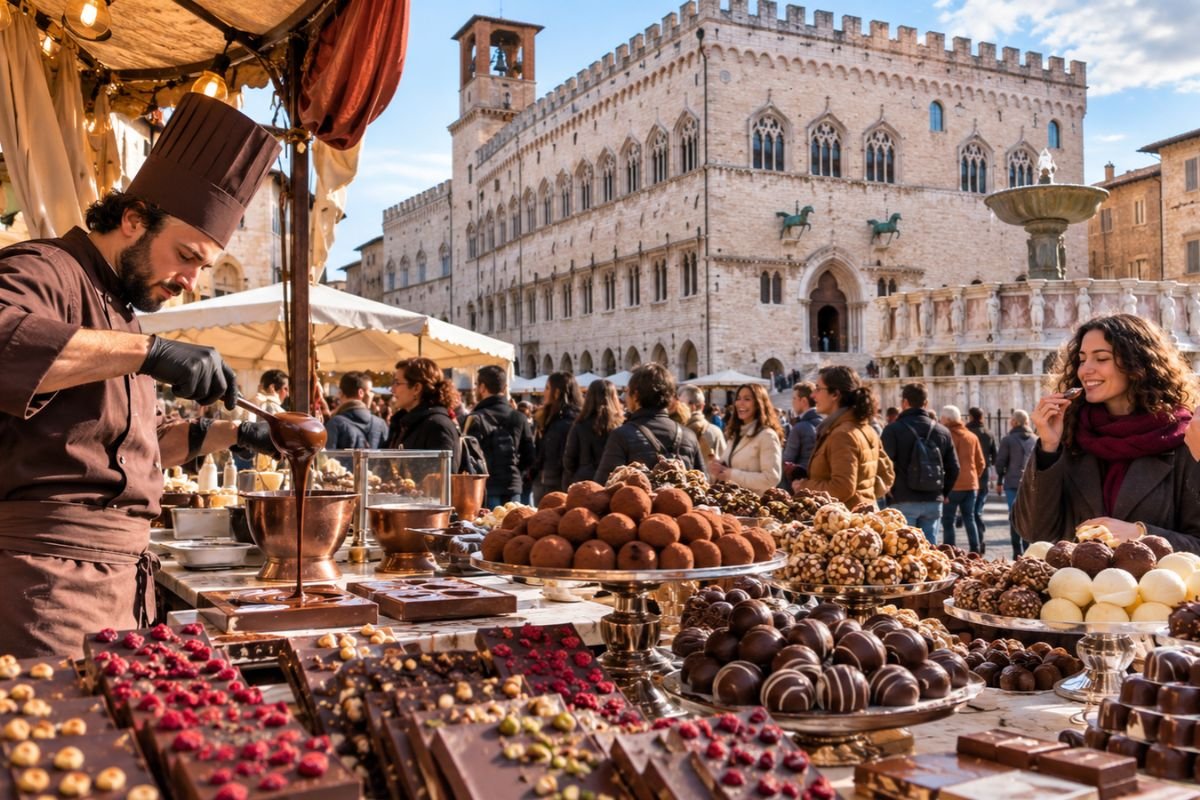
From 13 to 22 November 2026, the historic centre of Perugia becomes the setting for Eurochocolate, one of Italy’s best-known celebrations of cocoa and confectionery. The 32nd edition brings together more than 130 exhibitors, tastings, workshops and family activities across the squares and streets of Umbria’s capital.
A visit offers more than a chance to buy sweets. The festival gives travellers a reason to explore a hilltop city with Etruscan roots, medieval palaces and a long association with chocolate making. It also invites a closer look at where cocoa comes from, how skilled makers transform it, and why two bars containing similar ingredients can taste completely different.
How Perugia became a chocolate city
The first Eurochocolate took place in 1994, but Perugia’s connection with confectionery reaches further back. Perugina was founded here in 1907, and its Baci chocolates, introduced in 1922, became one of Italy’s most recognisable sweet gifts. Their success helped give the city a reputation that extends well beyond Umbria.
Rather than confining the event to an exhibition hall, Eurochocolate turns Perugia’s streets into an open-air route through chocolate culture. Visitors move from a craft producer to a tasting, then pass a medieval façade or a panoramic terrace on the way to the next activity. The setting matters: it is the city itself that connects the different parts of the festival.
Fate Dolci – the idea behind the 2026 edition
This year’s theme, “Fate Dolci”, plays on an Italian expression meaning “make sweets” and on the word for fairies. The emphasis is on participation. Chocolate is not presented solely as something to unwrap and eat: the programme encourages guests to watch professional demonstrations, discover ingredients and, in designated workshops, make small creations themselves.
The main festival areas include Corso Vannucci, Piazza Italia, Piazza Matteotti, Piazza della Repubblica, Via Mazzini, Via Fani and Giardini Carducci. Each has a different role, from the busy market stalls to spaces for guided tastings and discussions. The result is a walkable event, although Perugia’s steep streets and changes in level are worth allowing for.
Chocolate Show – more than six thousand products
The Chocolate Show is the large open-air marketplace at the heart of Eurochocolate. For 2026 the organisers announce over 130 exhibitors and more than 6,000 chocolate products. Established Italian names stand alongside smaller artisan workshops, making it possible to compare milk chocolate, intense dark varieties, filled pralines and regional specialities in one place.
A useful way to explore the stalls is to taste selectively rather than buy the first attractive assortment. The proportion of cocoa is only part of the story: bean origin, roasting, texture and added ingredients all affect flavour. At some stands the producers themselves can explain their choices, an opportunity that is often missing when chocolate is bought from a supermarket shelf.
A new Free From area on Via Mazzini brings together options for different dietary preferences, including products without added sugar, lactose-free and gluten-free ranges, and vegan chocolate. These labels describe different recipes, so visitors with specific dietary requirements still need to check each product individually.
ChocoLab – tasting and learning with the makers
ChocoLab is devoted to the craft and culture behind the finished product. Experts, chocolate makers and producers lead talks and tasting sessions that explore cocoa varieties, processing techniques and flavour. The setting is linked with the history of Luisa and Annibale Spagnoli, founders of Perugina, adding a local story to a programme that looks around the world.
Among the official appointments are tastings of craft chocolate from Côte d’Ivoire and a series devoted to bean-to-bar producers. A bean-to-bar maker processes cocoa beans into chocolate rather than starting with a ready-made industrial chocolate base. This approach can reveal differences between harvests and growing regions, although skill and careful processing remain just as important as origin.
Some sessions examine unexpected food pairings, while others explain how to assess aroma, the snap of a chocolate bar and the changing sensations as it melts. These guided events have limited places, and some require booking. Their schedules and conditions are published in the official programme rather than being covered by a general festival admission.
Cocoa-growing countries and the special guests
Côte d’Ivoire is the international guest of honour for 2026. As a major cocoa-producing country, it introduces a perspective often overlooked at European chocolate festivals: the people who grow, ferment and transform the beans before they reach a confectioner. The programme offers encounters with local craft producers and discussion of the value created in countries of origin.
The Italian regional guest is Calabria. Its citrus fruits, including bergamot, and traditional pastries provide a natural starting point for exploring combinations with cocoa. Sessions devoted to regional ingredients show how chocolate can be part of a wider culinary tradition instead of remaining an isolated dessert.
At Eurochocolate World in Giardini Carducci, visitors can also discover producers linked to more than twenty cocoa-growing territories across Africa, Asia and Latin America. The distinction between bean-to-bar and tree-to-bar is explained through examples of producers who control different stages of the process, from cultivation to the finished bar.
A festival families can take part in
For children, Fate Lab at the former commodities exchange on Via Mazzini is one of the most distinctive areas. Created with ICAM and Fabbri, it offers hands-on activities in which young participants make themed chocolate lollipops and other small sweets. The official daily hours for this activity are 10:00 to 19:00.
Piazza Matteotti hosts Spazio Fate Dolci, with displays, new recipes and demonstrations involving local confectioners. Street performers and the changing atmosphere of the centre provide breaks between workshops, making it possible to build a visit around several shorter activities rather than expecting children to sit through a full day of formal presentations.
Perugia beyond the chocolate stalls
The festival is also an excellent introduction to Perugia on ItalianAirports.eu. Piazza IV Novembre is the natural starting point, with the thirteenth-century Fontana Maggiore, the cathedral of San Lorenzo and the imposing Palazzo dei Priori. Inside the palace, the Galleria Nazionale dell’Umbria preserves paintings that help explain the city’s artistic importance.
A different layer of history appears at the Etruscan Arch, while the underground remains of Rocca Paolina show how later rulers reshaped the medieval city. A walk along Corso Vannucci reveals why the festival works so well here: celebrated monuments, cafés, viewpoints and busy squares are linked by a compact centre.
Chocolate enthusiasts can extend their visit to the city’s chocolate museums or the Casa del Cioccolato Perugina in San Sisto. The latter is outside the main festival area and should be treated as a separate outing. Guided city visits, where available through independent local guides, can provide historical context without confusing the festival with a tour service.
Reaching the festival from Italy’s airports
Perugia San Francesco d’Assisi Airport (PEG) is the closest airport. Its route network is smaller than that of Rome’s airports, so the best choice depends on available flights. Local buses, taxis and independently arranged private airport transfers are among the onward options; timetables and pickup arrangements need to be checked for the date of arrival.
Travellers landing at Rome Fiumicino (FCO) or Ciampino (CIA) can continue towards Umbria by rail and other public transport, usually with a change or a connection through Rome. Florence Airport (FLR) is another possible arrival point for a trip combining Tuscany and Umbria. Private car journeys can avoid station changes, but travel time and cost depend on the actual route and operator.
ItalianAirports.eu is an information portal, not the company operating the journey. Its Perugia on ItalianAirports.eu page helps readers place the city within Italy’s airport and destination network. Dedicated transfer-service links are not included here because a verified, separate booking page for these specific journeys has not been established.
Getting around Perugia during Eurochocolate
Perugia’s old town has restricted-access streets, and many festival areas are intended for pedestrians. Drivers should not assume that a vehicle can stop beside the main stalls. The Minimetrò connects the Pian di Massiano area with a station close to the centre, providing an alternative to attempting to park in the historic streets.
A one-day visit is enough to sample the market, see the main squares and attend one chosen activity. With an overnight stay, there is time for a more relaxed exploration of the museums, the Etruscan and medieval city and perhaps a separate visit to Perugina. The busiest periods are likely to be the weekends, when both the festival and ordinary city life compete for space.
Dates, opening hours and admission
Eurochocolate runs from Friday 13 to Sunday 22 November 2026. The organisers state that admission to the streets and squares of the festival is free. The stalls are scheduled to open Monday to Friday from 10:00 to 19:30, on Saturdays from 09:30 to 22:00 and on Sundays from 09:00 to 20:00.
Selected tastings, workshops and museum visits can have separate admission or reservation conditions. The event is planned to take place even in wet weather, though some activities are outdoors. The official Eurochocolate website and official festival programme contain the current event details, locations and booking information.
Eurochocolate is worth visiting not simply for the quantity of sweets but for the contrast between a working historic city and a festival devoted to craftsmanship. Tasting chocolate from different origins in the morning, studying medieval art in the afternoon and returning to a maker’s demonstration in the evening makes Perugia a memorable autumn destination.